
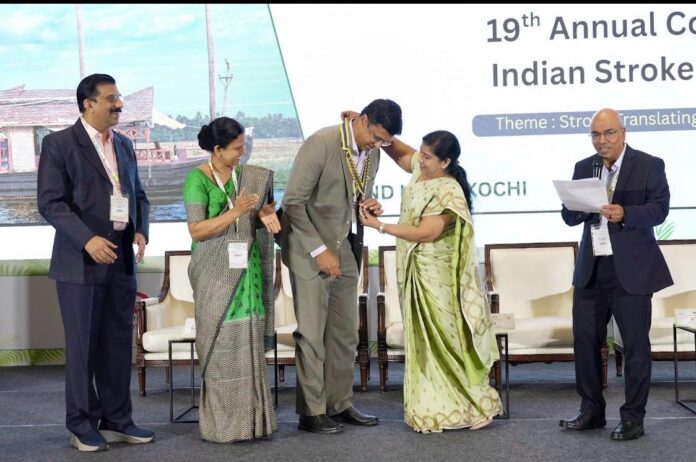

Stroke remains one of the leading causes of death and disability in India, yet experts emphasize that it is largely preventable and treatable when recognised early. With Dr. Vikram Huded assuming office as the President of the Indian Stroke Association (ISA), the organization aims to strengthen stroke awareness, expand access to timely treatment, and build a more coordinated stroke care system across the country.
Dr. Huded is a leading interventional neurologist and Director and Clinical Lead for the Interventional Neurology Program at Narayana Health. He also serves as Head of Neurology and Senior Consultant in Interventional Neurology. Over the years, he has played a pivotal role in advancing neuro-intervention and stroke care services across India.
Focus on Early Stroke Recognition and Timely Treatment
Sharing his vision after assuming the role, Dr. Vikram Huded highlighted the urgent need to improve stroke recognition and treatment in India.
“It is a great honour and privilege to serve as the President of the Indian Stroke Association. Stroke continues to be one of the leading causes of death and disability in our country. However, the encouraging reality is that stroke is both preventable and treatable when recognized early and managed appropriately. Timely recognition and intervention can save not only the brain but also the dignity, independence, and future of families,” he said.
Bridging the Gap in Stroke Treatment in India
Despite significant advances in stroke care worldwide, India still faces major challenges in delivering timely treatment.
According to recent studies by the Indian Council of Medical Research (ICMR), intravenous thrombolysis—a life-saving treatment for acute stroke—is administered to less than 5% of stroke patients in India. Similarly, mechanical thrombectomy, an advanced procedure used to remove blood clots from brain arteries, is performed in less than 1% of patients.
In contrast, developed countries in the region, such as Singapore, report treatment rates of nearly 30%.
“These numbers clearly show that the science already exists. Our responsibility now is to ensure that these life-saving treatments reach every patient who needs them,” Dr. Huded added.
‘Save the Brain’ Initiative to Boost Stroke Awareness
To address this gap, the Indian Stroke Association will focus on awareness, education, collaboration, and action during Dr. Huded’s tenure.
One of the key national initiatives will be “Save the Brain”, a campaign designed to improve stroke awareness among both the general public and healthcare professionals.
As per the press release, the initiative will emphasize a simple yet powerful message: “Stroke is preventable. Stroke is treatable.”
Through public awareness campaigns, physician engagement programmes, and collaborative healthcare initiatives, ISA aims to spread the critical message that “Time is Brain”, encouraging patients to reach hospitals quickly and receive life-saving treatment.
Celebrating 100 Years of Cerebral Angiography
The coming year will also mark the centenary of cerebral angiography, a groundbreaking medical procedure first performed in 1927 by neurologist Egas Moniz. This discovery revolutionized the understanding of cerebral circulation and laid the foundation for modern neurovascular imaging and interventions.
To commemorate this historic milestone, the Indian Stroke Association plans to organize 100 Continuing Medical Education (CME) programmes across India.
These educational initiatives will encourage academic exchange, multidisciplinary collaboration, and training for the next generation of neurologists, neurosurgeons, neuroradiologists, stroke specialists, and neurointerventionalists.
Strengthening Stroke Care Systems in India
As India works toward its vision of becoming a developed nation by 2047, strengthening healthcare systems and reducing the burden of diseases such as stroke will be essential.
Dr. Huded emphasized that improving stroke prevention, early diagnosis, timely treatment, and rehabilitation will remain a key priority for the Indian Stroke Association.
However, he noted that achieving these goals requires collective action from the entire neuroscience community.
“ISA will continue working to improve stroke prevention, awareness, and treatment across the country. Together, we can build stronger stroke systems of care, empower young clinicians, and ensure that scientific advances translate into better outcomes for patients. Stroke is preventable. Stroke is treatable. Together, let us ‘Save the Brain’ and save lives,” he said.
ISA Expands National Stroke Awareness Efforts
Echoing similar sentiments, Dr. Arvind Sharma, Secretary of the Indian Stroke Association, congratulated Dr. Huded on assuming the leadership role and reaffirmed the association’s commitment to expanding stroke awareness initiatives.
“The Indian Stroke Association has more than 1,400 stroke neurologists across India. As part of our mission, we have been training physicians nationwide to partner with us in stroke advocacy. Together, we aim to strengthen awareness, promote early diagnosis, and expand access to advanced stroke treatments,” he said.
ISA has been running annual campaigns to promote stroke awareness. In 2024, the campaign theme was “Mission Brain Attack,” followed by “Time to Act Now” in 2025. This year, the theme will be “Save the Brain.”
To further amplify awareness, the association will conduct national programmes, press conferences, and public outreach initiatives in collaboration with organizations such as the Rotary Club, the Indian Medical Association (IMA), and the Association of Physicians of India (API).
Through these collaborative efforts, ISA aims to improve public awareness of stroke symptoms, encourage faster medical response, and ultimately reduce stroke-related deaths and disabilities across India.