
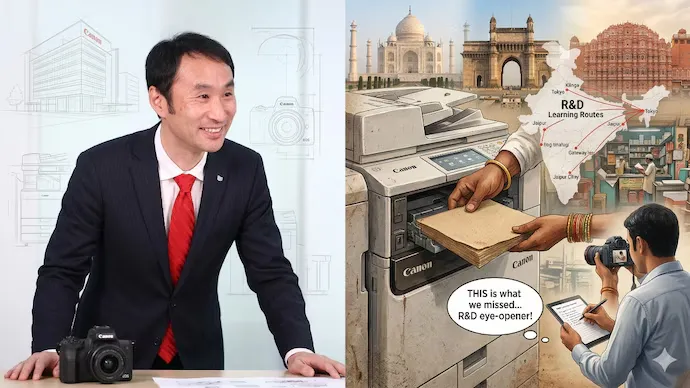

New Delhi: Canon has identified India as a crucial hub for research and development (R&D), with the company leveraging the country’s unique consumer behavior and diverse market needs to drive innovation across its global product portfolio.
Speaking on the company’s strategy, Toshiaki Nomura, President and CEO of Canon India, said that insights from Indian users—ranging from small-town print shops to the booming wedding photography industry—are actively shaping product development. Japanese engineers frequently visit Indian cities to study real-world usage, leading to new design improvements and global feature enhancements.
Diversification Beyond Cameras
Founded in 1937, Canon has evolved from a camera-focused company into a diversified technology player. Its core business today includes imaging and printing solutions, alongside a growing presence in advanced sectors such as medical diagnostics and semiconductor equipment. The company’s medical imaging portfolio includes technologies like CT scans and X-ray systems, which are increasingly contributing to its global business.
Supporting India’s Semiconductor Push
As India accelerates efforts to build a domestic semiconductor ecosystem, Canon is aligning itself with this vision by supplying critical chip manufacturing equipment. While it does not produce semiconductors, the company plays an enabling role in fabrication processes. Canon has also expanded into the space segment, developing compact satellites using its expertise in optics and sensor technologies.
India as a Source of Innovation
Canon highlighted that India’s unique usage patterns often lead to unexpected innovations. According to Nomura, local adaptations—particularly in printing and imaging—have influenced product features that were later implemented globally, resulting in improved performance and increased sales.
Complex but High-Growth Market
The company views India as a highly diverse market, comparable to managing multiple regions within a single country. This diversity, however, offers strong growth potential. Notably, the wedding photography segment accounts for nearly 60% of Canon’s imaging revenue in India. Additionally, the rise of OTT platforms and digital content creation is opening new avenues for growth.
Smartphones Seen as Complementary
Addressing competition from smartphones, Canon maintains that mobile devices complement rather than replace dedicated cameras. The company believes smartphones often act as an entry point for photography enthusiasts, eventually driving demand for high-end imaging solutions.
AI Integration Without Hype
Canon is steadily incorporating artificial intelligence into its products, focusing on functionality over branding. AI-driven features such as subject tracking in cameras and predictive maintenance in printers are being deployed to enhance user experience and operational efficiency.
Focus on Customer Support
Reinforcing its commitment to the Indian market, Canon has built a strong after-sales network with over 600 authorized service centers across the country. The company emphasized that robust customer support remains central to its long-term strategy, helping strengthen relationships and sustain growth in India.